Every country has a name. Very few have five.
This one has been called Bharat, Jambudvipa, Aryavarta, Hindustan, and India — and that’s just the short list. Each name was given by different people, in different centuries, for different reasons. So why is India called Bharat, and where did all its other names come from? Line them up and they read almost like a diary: a record of everyone who ever looked at this land and tried to put it into a word.
But of all those names, one is older and deeper than the rest. It’s the name the land gave itself, long before any foreigner arrived to rename it.
That name is Bharat. And behind it is a story most people have never actually heard.
One land, many names
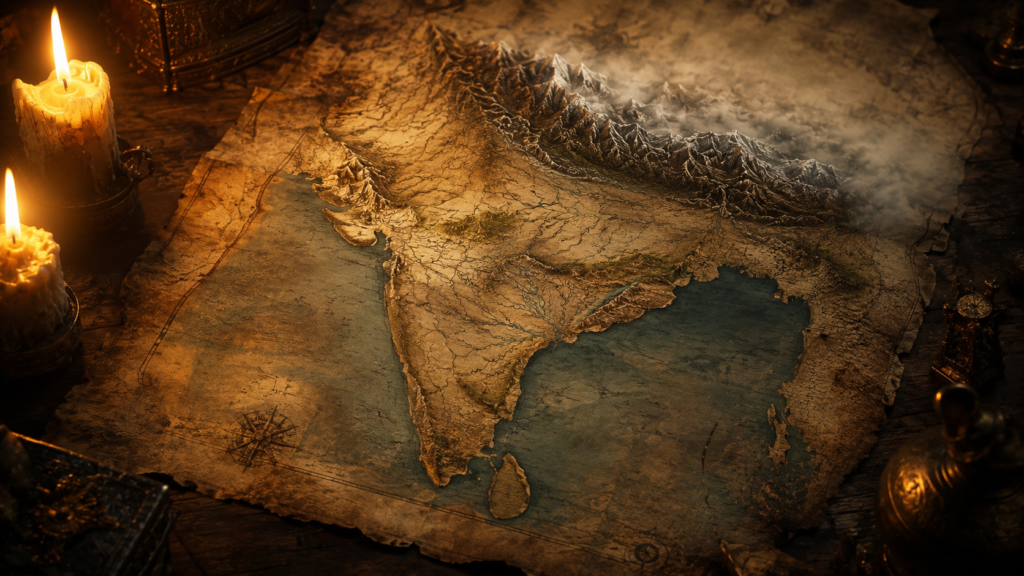
Over thousands of years, this land has answered to many names. Each came from a different people, looking at it from a different direction — and that’s the whole story in miniature.
– Bharat / Bharatvarsha — the oldest self-given name, rooted in the Vedas and Puranas, traditionally said to come from a king named Bharata.
– Jambudvipa — “the land of the jambu (rose-apple) tree,” used across ancient Hindu, Buddhist, and Jain literature.
– Aryavarta — “the abode of the Arya,” the noble or civilized people; historically the region between the Himalayas and the Vindhya mountains.
– Sindhu / Hindu — from the great Indus (Sindhu) river, the root that outsiders later turned into Hindustan.
– Indos / India — what the ancient Greeks called it, also from the river Sindhu.
Notice the pattern already forming: the people who lived here used one kind of name; the people who arrived from outside used another. Hold on to that — we’ll come back to it.
Start with a boy and a lion
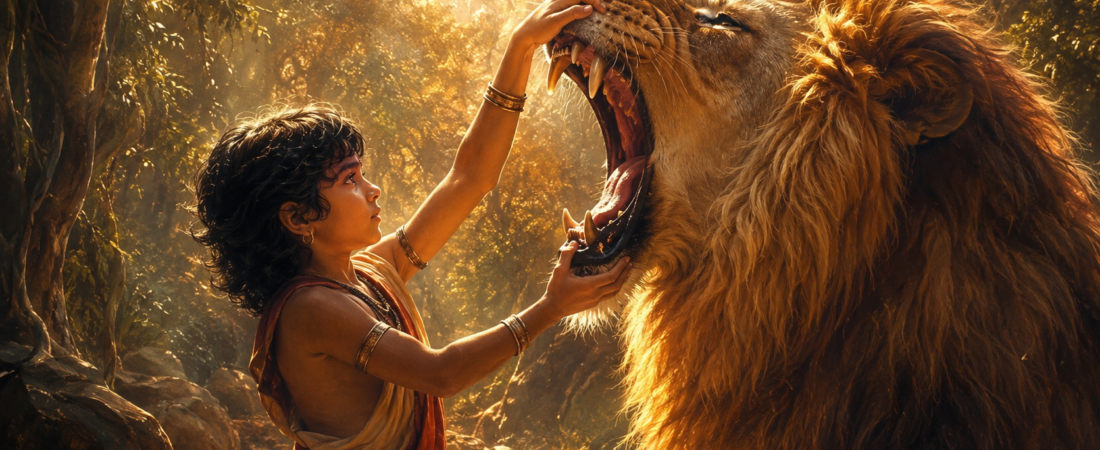
Forget maps and borders for a moment. The story of Bharat begins, according to the oldest tradition, with a child.
His name was Bharata, the son of King Dushyanta and a forest-raised woman named Shakuntala. He grew up not in a palace but in a hermitage in the wilderness — and the legends remember him for one astonishing habit. As a small boy, he would walk up to lions and tigers, pry their jaws open, and count their teeth. Not out of cruelty. Out of pure fearlessness. The animals, the stories say, simply let him.
That boy grew into an emperor. And when he did, the land itself, it is said, took his name: Bharatavarsha — “the land of Bharata.”
It’s a small detail, but it tells you everything about how this civilization thought. Other lands were named after rivers, mountains, or the people who conquered them. This one chose to be named after a person known for being unafraid.
A quick, honest detour
Here’s where a careful storyteller has to be honest, because this is exactly the kind of fact that gets repeated wrongly.
There isn’t just one Bharata. The tradition actually offers a few:
– Bharata, son of Dushyanta and Shakuntala — the Mahabharata lineage, the most famous version.
– Bharata, son of Rishabha — the figure named in the Bhagavata Purana and revered in Jain tradition.
– The Bharatas — a powerful tribe mentioned in the Rigveda, the oldest layer of all.
So which one really gave the land its name? The truth is, nobody can say for certain. But notice something: the name “Bharata” appears independently across the Vedas, the Puranas, the epics, and Jain texts. A name that turns up that many times, in that many separate traditions, isn’t a footnote. It’s a foundation.
The name written into the epics
If “Bharat” were a modern invention — a recent bit of national pride — you wouldn’t find it in the oldest texts. But you do, again and again.
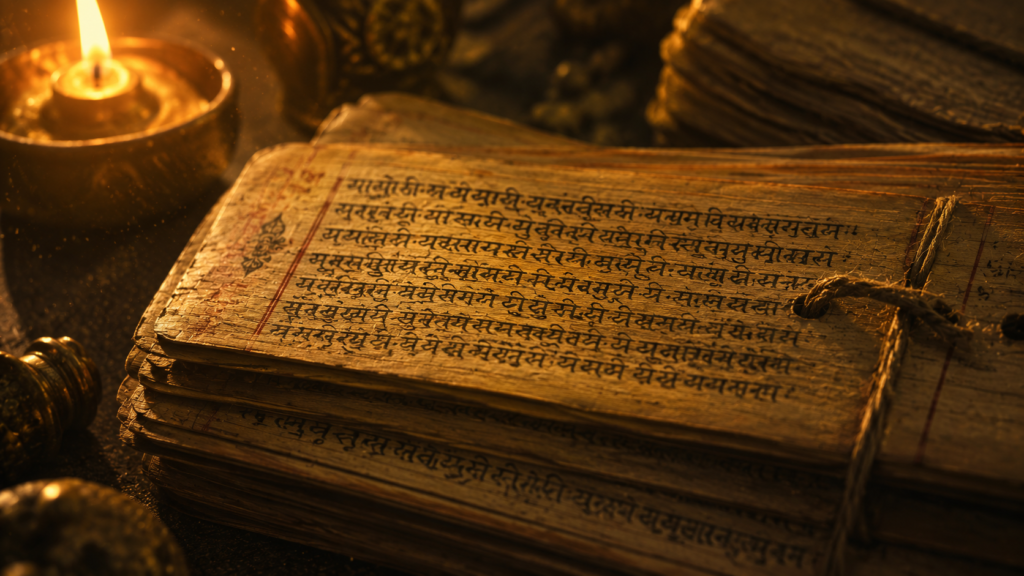
In the Ramayana
When Sugriva sends his vanara armies north to search for Sita, he describes the land using the word Bharata (Kishkindha Kanda):
उत्तरं भारतं सर्वं नानाजनपदाकुलम् ।
अन्वेष्टुं त्वं गमिष्यामि सीतायाः पदमुत्तमम् ॥
“I shall go to search for the noble footprints of Sita across all of northern Bharata, which is filled with many kingdoms.”
And again in the Bala Kanda, in praise of King Dasharatha’s reign:
तस्य भूमिपतेर्भूमिर्भरतस्येव भूपतेः ।
समृद्धा सस्यसम्पन्ना सदा निरुपद्रवा ॥
“The land of this king was prosperous, abundant with crops, and always free from calamity — just like the land of King Bharata.”
In the Mahabharata
When Sanjaya describes this land to the blind king Dhritarashtra, he doesn’t call it India. He calls it Bharatavarsha — and something more, a karma-bhumi, a “land of action” (Bhishma Parva):
इदं तु भारतं वर्षं सर्वेषामेव भूभृताम् ।
कर्मभूमिरिति ख्यातं स्वर्गारोहणहेतुकम् ॥
“This land is known as Bharatavarsha among all the lands of the earth — famed as the land of action, from which one may rise to heaven.”
And the epic is explicit about why it carries the name (Adi Parva):
अस्मिन् वंशे महाराज भरतो नाम राजभूत् ।
यस्य नाम्ना तु भारतमिदं वर्षमिहोच्यते ॥
“In this lineage there was a ruler named Bharata — and it is after him that this land is called Bharata.”
In other words: thousands of years ago, the people who lived here already had a name for home. We just stopped using it.
So where did “India” come from?
If the land called itself Bharat, where did “India” come from? And no — despite a popular myth, the British did not invent it.
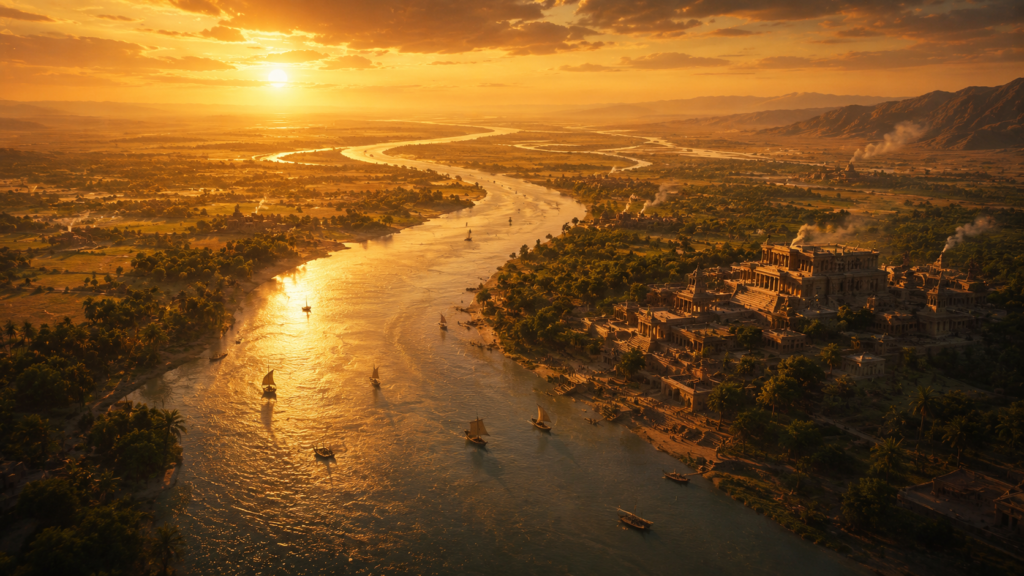
The real journey is far older, and frankly more interesting. It starts with a river. The mighty Indus was called Sindhu in Sanskrit. The Persians, to the west, couldn’t quite manage the “s” and turned it into Hindu. The Greeks borrowed that and made it Indós — Herodotus was already writing about India some 2,500 years ago. From Greek it slid into Latin as India, and from Latin, eventually, into English.
So “India” isn’t a colonial label stamped on by the British. It’s a 2,500-year-old game of telephone that began with a single river — a name passed from tongue to tongue until it circled back home. (That same river, by the way, is the root of Hindu and Hindustan too. One river, three names.)
The pattern hiding in the names
Once you see it, you can’t unsee it. The name a land is given depends on where you’re standing.
– The people who lived here called it Bharat — a name from the inside, drawn from their own kings and their own epics.
– The people who arrived from the west named it after the first great thing they crossed: the river Sindhu. That gave us Hindustan and India — names from the outside.
Neither is “fake.” They’re just different points of view. India is what the world called this place. Bharat is what this place called itself.
Bharatvarsha was bigger than you think
One last surprise. When the old texts speak of Bharatavarsha, they don’t mean the India you see on a modern map. They mean something much larger — a civilizational space stretching across what is today India, Pakistan, Bangladesh, Nepal, Bhutan, and parts of Afghanistan. Many of the kingdoms named in the Mahabharata sat in lands that now lie beyond India’s borders entirely.
The Vishnu Purana sketches it simply: the land that lies north of the ocean and south of the snowy mountains. Not a country with fences and checkpoints — a shared idea of belonging, held together by stories rather than borders.
Three names, three souls
Here’s the most interesting thing of all: this land’s three great names don’t just come from different places — they describe three different kinds of thing.
Bharat was a civilization. Before it was ever a country, it was an idea — a way of seeing the world. In Bharatvarsha, the subjects we now keep in separate boxes were treated as one connected whole: astronomy (Jyotisha) measured sacred time, medicine (Ayurveda) tied the body to the rhythms of nature, and spirituality (Vedanta) asked what consciousness itself was made of. The stars, the body, and the soul were all part of a single conversation. Bharat, in other words, was about the pursuit of knowledge and dharma — righteous living.
Hindustan was an empire — and a fusion. The name belongs to a later age, when the Persian and Central Asian worlds met the Indian one and blended into something neither could have made alone. This is the Hindustan of the Taj Mahal and the Red Fort, of Urdu poetry, of gardens and music and grand courts. It was about synthesis — many cultures becoming one composite whole.
India is a nation. The newest layer of all. Born in 1947 as a democratic republic, knit together from hundreds of languages and peoples under a single constitution. From the Vedas to ISRO, it carries the older layers inside it — but as an idea, modern India is about unity in diversity, and claiming its place at the modern world’s table.
Civilization, empire, nation. Three names — and each one is really a different answer to the same question: what is this place?
Why a name still matters
We tend to treat names as labels — interchangeable, disposable. But a name is really a memory. It carries inside it the people who first spoke it and what they cared about.
“India” remembers a river, and the travellers who crossed it.
“Bharat” remembers a fearless boy who became an emperor, and a civilization confident enough to name itself after one of its own.
Both names are true. Both are old. And the fact that this land answers to so many of them isn’t confusion — it’s proof of how long it has been here, and how many different eyes have looked upon it and thought, this place deserves a name.
Before India was India, it was Bharat. And in a way, it still is.
Enjoyed this? I write fact-checked stories of forgotten Bharat — its people, ideas, and lost knowledge. Subscribe / follow so you don’t miss the next one. Coming soon: how ancient Bharat tied together the stars, the body, and the soul into a single science.